

THE THAMES THROUGH TIME: THE ARCHAEOLOGY OF THE GRAVEL TERRACES OF THE UPPER AND MIDDLE THAMES
Written by Anthony Morigi, Danielle Schreve, Mark White, Gill Hey, Paul Garwood, Mark Robinson, Alistair Barclay, Philippa Bradley
Published by Oxford University School Of Archaeology
in 2011
ISBN: 9780954962784
- Categorised in:
- TOPOGRAPHY (UK)
- TOPOGRAPHY (UK GENERAL)
- RIVERS
- ARCHAEOLOGY
- PREHISTORIC
- NEOLITHIC
- BRONZE AGE
- HISTORY
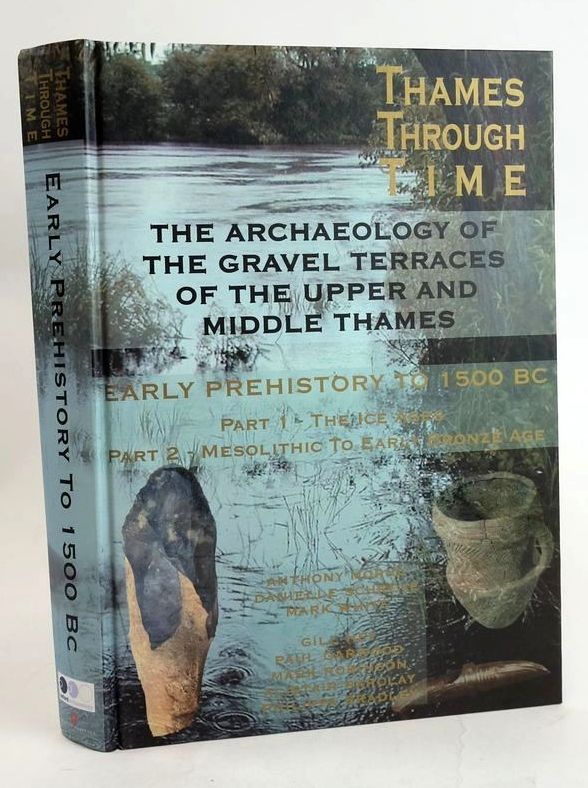 View more images
THE THAMES THROUGH TIME: THE ARCHAEOLOGY OF THE GRAVEL TERRACES OF THE UPPER AND MIDDLE THAMES
Written by Anthony Morigi, Danielle Schreve, Mark White, Gill Hey, Paul Garwood, Mark Robinson, Alistair Barclay, Philippa Bradley.
Stock no. 1829516
1st.
2011.
Hardback.
Large format.
Slightly better than very good condition.
Early Prehistory to 1500 BC. Part I - The Ice Ages; Part 2 - Mesolithic to Early Bronze Age. Oxford Archaeology Thames Valley Landscapes Monograph No. 32. Large format. Heavy. Pictorial boards. Colour & b/w illustrations. xxvi and 521 pages including index. ISBN: 9780954962784. Crinkling to to margins of pages 179-186 else a lovely copy.
Front cover
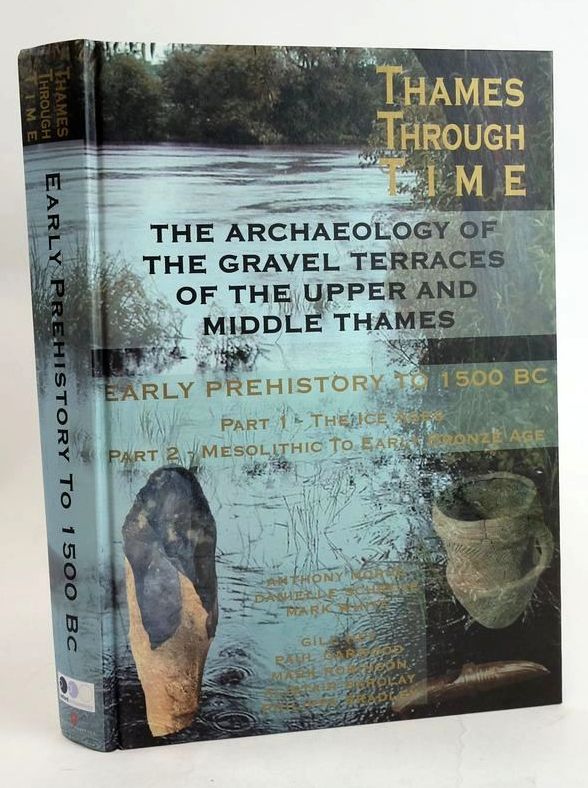
Contents
- PART 1 - THE ICE AGES: PALAEOGEOGRAPHY, PALAEOLITHIC ARCHAEOLOGY AND PLEISTOCENE ENVIRONMENTS
- Chapter 1 - Introduction and teh Pre-Anglian Geological, Palaeo-Environmental and Archaeological Records by Anthony Morigi, Danielle Schreve and Mark White
- Chronostratigraphy
- North-Western European Setting of teh River Thames System
- Topography and Geology of the Thames Catchment: An Overview
- An overview of the river terrace deposits of the Thames
- Climatic controls on Thames terrace formation
- Tectonic controls on Thames terrace formation
- Nomenclature of the river terrace deposits
- The Early and Middle Pleistocene Environment and Occupation
- The Early Pleistocene
- The early Middle Pleistocene
- The earliest occupation of Britain
- Upper and Middle Thames
- Hominin behaviour in the Lower Palaeolithic
- CHAPTER 2 - THE DIVERSION OF THE THAMES, THE HOXNIAN INTERGLACIAL AND ADJACENT COLD STAGES (MIS 12-11-10) by Danielle Schreve, Anthony Morigi and Mark White
- The Anglian Glaciation
- The diversion of the Thanes
- Palaeogeography of the terrace deposits
- Correlation of the terrace deposits
- Archaeology and Palaeontology of the Anglian Glaciation
- The Hoxnian Interglacial
- Sites outside the main area
- Key sites in the Upper and Middle Thames
- Key Debates in Hoxnian Archaeology
- Clactonian-Acheulian
- Hominin landscapes and habitats
- Handaxe variation
- CHAPTER 3 - THE 'PURFLEET' INTERGLACIAL AND ADJACENT COLD STAGES (MIS 10-8) by Mark White, Danielle Schreve and Anthony Morigi
- Palaeogeography of the Terrace Deposits
- Correlation of the terrace deposits
- The Archaeology and Palaeoenvironment of the 'Purfleet' Interglacial
- Levallois technology and the early Middle Palaeolithic
- Behavioural changes a teh Lower-Middle Palaeolithic transition
- CHAPTER 4 - THE 'AVELEY' INTERGLACIAL AND ADJACENT COLD STAGES (MIS 8-6) by Anthony Morigi, Mark White and Danielle Schreve
- Palaeogeography of teh Terrace Deposits
- Correlation of teh terraces
- Archaeology and Palaeontology
- Finds outside the study area
- Sites in the main area
- Human behaviour and population dynamics of MIS 7
- CHAPTER 5 - THE ARCHAEOLOGY OF ABSENCE IN THE LATE PLEISTOCENE (mis 6-4) by Danielle Schreve, Mark White and Anthony Morigi
- Palaeogeography of the Thames Terraces
- Correlation of the terrace deposits
- Archaeology and Palaeontology
- Is the absence real or imaginary?
- How can the absence be explained?
- MIS 5E: The Ipswichian Interglacial
- MIS 5D-4: The Early Devensian
- CHAPTER 6 - THE MIDDLE AND LATE DEVENSIAN (MIS 3-2) by Mark White, Anthony Morigi and Danielle Schreve
- Palaeogeography of the Terraces
- Correlation of the terraces
- The Late Middle Palaeolithic
- The Early Upper Palaeolithic (EUP)
- CHAPTER 7 - THE TERMINAL PLEISTONCENE-EARLY HOLOCENE TRANSITION (MIS2-1), C 20-10 000 BP by Danielle Schreve, and Mark White with contributions by Gill Hey, Philip Jones, Anthony Morigi and Mark Robinson
- Palaeogeography of the Terraces
- Correlation of the terraces
- Lateglacial Humans and their Environment
- The Last Glacial Maximum
- The return of humans in the lateglacial (Windermere) Interstadial
- The Late Upper Palaeolithic
- The Final Upper Palaeolithic
- The last cold spell: the Younger Dryas/Loch Lomond stadial
- Later glacial environments
- Human occupation: Final Upper Palaeolithic 'long blade' industries
- PART 2: THE MESOLITHIC, NEOLITHIC AND EARLY BRONZE AGE AND THE ESTABLISHMENT OF PERMANENT HUMAN OCCUPATION IN THE VALLEY
- CHAPTER 8: AN INTRODUCTION TO THE HOLOCENE OF THE THAMES by Gill Hey with Chris Hayden
- Introduction to the Holocene of teh Thames
- The History of Research
- The Nature of the Evidence
- Preservational environments
- The state of preservation of archaeological remains
- Investigating Mesolithic, neolithic and early Bronze Age remains
- Chronology and Definitions: An Overview
- The role of material culture
- The impact of the radiocarbon dating on our understanding of the period
- A brief overview
- CHAPTER 9 - THE THAMES AND ITS CHANGING ENVIRONMENT IN OUR ERA by Mark Robinson
- Floodplain Creation at the end of the Devensian
- Palaeohydrology
- The Late Devensian to Holocene transition c 11,500 cal BP/9500 cal BC
- The Mesolithic c 9600-4000 cal BC
- The Neolithic c 4000-2500 cal BC
- The early Bronze Age c 2500-1500 cal BC
- Aquatic conditions
- Vegetational Succession
- The early Mesolithic (Flandrian Zone I, 9400-6000 cal BC)
- The late Mesolithic (Flandrian Zone II, 6000-4000 cal BC)
- The Elm decline and teh earliest Neolithic, c 4000 cal BC
- The Neolithic, c 4000-2500 cal BC)
- The early Bronze Age (2500-1500 cal BC)
- Middle Bronze Age postscript (1500 cal BC onwards)
- Origin and Development of Agriculture in teh Thames Valley
- CHAPTER 10 - MESOLITHIC COMMUNITIES IN THE THAMES VALLEY: LIVING IN THH NATURAL LANDSCAPE by Gill Hey with Mark Robinson
- Hunter-Gatherers
- Movement and Habitation in the Early Mesolithic
- The Kennet Valley
- Early Mesolithic habitation elsewhere in the Thames Valley catchment
- Later Mesolithic Habitation in teh Thames Valley
- Mesolithic Lifeways
- Hunter-Gatherers and Natural Resources
- CHAPTER 11 - NEOLITHIC COMMUNITIES IN THE THAMES VALLEY: THE CREATION OF NEW WORLDS by Gill Hey with Mark Robinson
- World in Transition: Changing Landscapes of the Early 4th Millennium CAL BC
- Inherited landscapes
- Changing landscapes
- Woodland clearance
- The evidence from three-throw holes
- The Creation of New Worlds
- Hoses
- Middens
- Artefact Scatters
- Pits
- New objects and materials
- New foods
- Animal and dairying
- Cereals
- Becoming 'Neolithic'
- Neolithic Habitation: Living in an Altered Landscape
- The early Neolithic settlement of the Thames Valley
- Later Neolithic land use and teh social landscape
- CHAPTER 12 - INSCRIBING THE LANDSCAPE: NEOLITHIC FUNERARY AND CEREMONIAL MONUMENTS by Gill hey and Alistair Barclay
- Constructing Monuments and Burying the Dead
- The Earliest Monuments
- The Cotswolds monuments
- Early monuments on the Chalk
- Funerary and other small monuments of the 4th millennium on the river gravels
- Causewayed Enclosures
- Cursus Monuments and Bank Barrows
- Henges
- Stone and Timber Circles
- Monument Complexes
- CHAPTER 13 - DOMESTICATING THE LANDSCAPE: SETTLEMENT AND AGRICLTURE IN THE EARLY BRONZE AGE by Gill Hey with Mark Robinson
- The End of the Neolithic, the Beginning of the Bronze Age, and teh Beaker Phenomenon
- Settlement at the Beginning of the Bronze Age
- Bronze Age Settlement in teh Early 2nd Millennium CAL BC
- Evidence for Change in Early Bronze Age Settlement
- Landscape, Land Use and Farming
- A Changed Landscape
- CHAPTER 14: RITUAL, CEREMONY AND COSMOLOGY by Paul Garwood with Gill Hey and Alistair Barclay
- Ritual Practices and Ceremonial Monuments by Paul Garwood
- Interpreting ritual and ceremony
- Ritual and material culture: special objects and structured deposits
- Sacred places: space, knowledge and ceremonial architecture
- The creation of sacred landscapes: ritual and cosmography
- Interpreting Neolithic Ceremonial Monuments and Depositional Practices by Alistair Barclay with Paul Garwood and Gill Hey
- The simple tombs of teh north-east Cotswolds
- Long barrow, cairns and mortuary structures
- Causewayed enclosures
- Cursus monuments and related structures in the Thames Valley
- Henges
- Neolithic round barrow, ring ditches and pit circles
- Earth, Ceremony and Monumental Architecture in teh Beaker Period and Early Bronze Age by Paul Garwood
- Round barrows as ceremonial architecture
- Round barrow groups as ceremonial complexes
- Acts of Ritualised Deposition in Pits, Tree-Throw Holes and Middens by Alistair Barclay and Paul Garwood
- River Deposits and Votive Offerings by Alistair Barclay
- Ritual, Ceremony and Cosmography
- CHAPTER 15: MAKING THE DEAD by Paul Garwood with a contribution by Alistair Barclay
- Funerary Ritual and Society by Paul Garwood
- Early Neolithic Mortuary Practices: Imagining, Making and Celebrating the Dead by Paul Garwood
- Exceptional Events: Complex Burials in the Late 4th-Early 3rd Millennia CAL BC by Paul Garwood and Alistair Barclay
- A Time and a Place for the Cremation Cemetery by Paul Garwood and Alistair Barclay
- Beaker Period and Early Bronze Age Funerary Practices, 2500-1800 CAL BC by Paul Garwood
- Radical departures: Beaker funerary ritual and the late Neolithic ceremonial landscape
- Communities of the dead, single graves and mortuary symbolism, 2100-1800 cal BC
- Early Bronze Age Burials, Monuments and Landscape, 1900-1500 CAL BC by Paul Garwood
- The diversity and complexity of early bronze Age funerary practices
- Funerary deposition in 'open' arena and premound contexts
- Funerary deposition in 'closed' primary contexts sealed by mounds
- Satellite burials and complex early Bronze Age funerary architecture
- Burning events, pyres, and funerary display
- The elite dead: power and identity
- CHAPTER 16: MEANINGFUL MATERIALS: PROCUREMENT, PRODUCTION AND EXCHANGE by Alistair Barclay and Philippa Bradley
- Introduction
- Meaningful materials
- Exchange
- Deposition and discard
- Raw Materials
- Flint and stone
- Shell
- Clay Organic materials
- Metals
- Production and Craftsmanship
- Working stone and flint
- Knowledge of materials and craftsmanship
- Lithic assemblages and their analysis
- Mesolithic flintworking techniques
- Neolithic flintworking techniques
- Bronze Age flintworking techniques
- Stone working
- Amber
- Shale, lignite and jet
- Shells, fossils and other natural materials
- Faience
- Organic materials
- Woodworking
- Worked bone, horn and antler
- Textiles, fibres, leather and resin
- New Technologies
- Pottery: a novel technology
- The place of potting within the community
- Development of pottery production and decoration
- The first metalwork
- Glossary
- Bibliography
- Index