

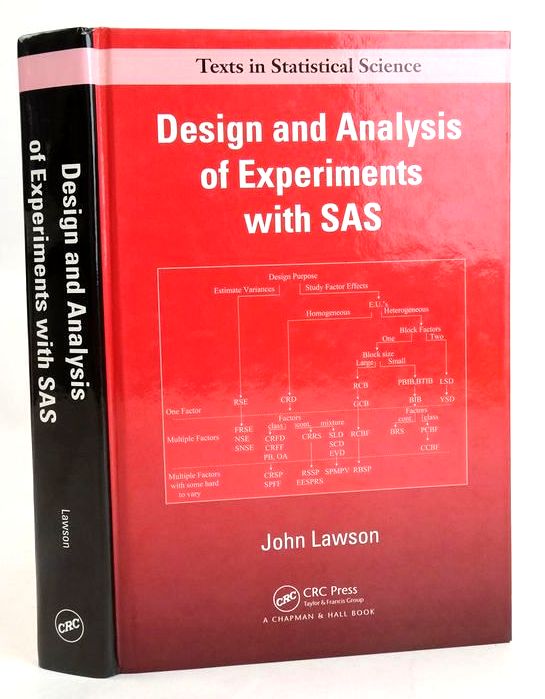
DESIGN AND ANALYSIS OF EXPERIMENTS WITH SAS (TEXTS IN STATISTICAL SCIENCE)
Written by John Lawson
Published by Chapman & Hall/Crc
in 2010
ISBN: 9781420060607
- Categorised in:
- MATHS
- SCIENCE AND TECHNOLOGY
- STATISTICS
- TEXT BOOK (UNIVERSITY)
- COMPUTING
 View more images
DESIGN AND ANALYSIS OF EXPERIMENTS WITH SAS (TEXTS IN STATISTICAL SCIENCE)
Written by John Lawson.
Stock no. 1830309
1st.
2010.
Hardback.
Slightly better than very good condition.
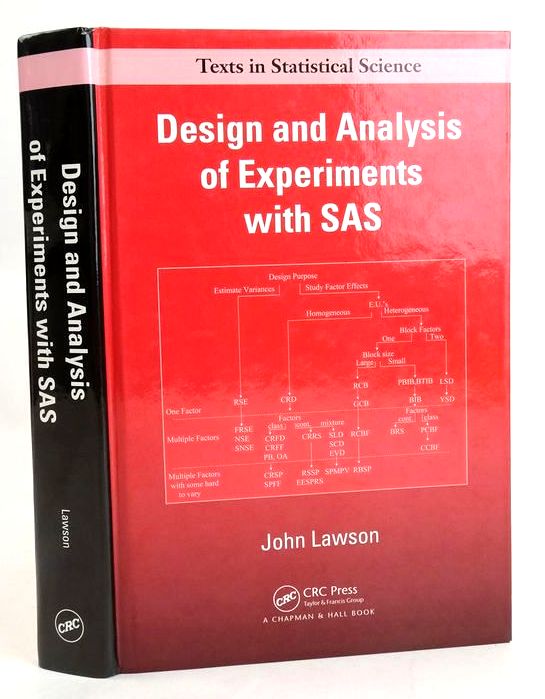
This book provides practical guidance on the computer analysis of experimental data. It connects the objectives of research to the type of experimental design required, describes the actual process of creating the design and collecting the data, shows how to perform the proper analysis of the data, and illustrates the interpretation of results. Red glazed boards. xiii and 582 pages including index. ISBN: 9781420060607. Slight lean to spine. Boards a little scuffed. Name in ink to front endpaper. Contents clean.
Front cover
Contents
- Preface
- 1 Introduction
- 1.1 Statistics and Data Collection
- 1.2 Beginnings of Statistically Planned Experiments
- 1.3 Definitions and Preliminaries
- 1.4 Purposes of Experimental Design
- 1.5 Types of Experimental Design
- 1.6 Planning Experiments
- 1.7 Performing the Experiments
- 1.8 Use of SAS Software
- 1.9 Review of Important Concepts
- 1.10 Exercises
- 2 Completely Randomized Designs with One Factor
- 2.1 Introduction
- 2.2 Replication and Randomization
- 2.3 A Historical Example
- 2.4 Linear Model for CRD
- 2.5 Verifying Assumptions of the Linear Model
- 2.6 Analysis Strategies When Assumptions are Violated
- 2.7 Determining the Number of Replicates
- 2.8 Comparison of Treatments after the F-Test
- 2.9 Review of Important Concepts
- 2.10 Exercises
- 3 Factorial Design
- 3.1 Introduction
- 3.2 Classical One at a Time versus Factorial Plans
- 3.3 Interpreting Interactions
- 3.4 Creating a Two-Factor Factorial Plan is SAS
- 3.5 Analysis of a Two Factor Factorial in SAS
- 3.6 Factorial Designs with Multiple Factors CRFD
- 3.7 Two Level Factorials
- 3.8 Verifying Assumptions of the Model
- 3.9 Review of Important Concepts
- 3.10 Exercises
- 3.11 Appendix - SAS Macro for Tukey's Single df Test
- 4 Randomized Block Design
- 4.1 Introduction
- 4.2 Creating an RCB in SAS
- 4.3 Model for RCB
- 4.4 An Example of an RCB
- 4.5 Determining the Number of Blocks
- 4.6 Factorial Designs in Blocks
- 4.7 Generalized Complete Block Design
- 4.8 Two Block Factors LSD
- 4.9 Review of Important Concepts
- 4.10 Exercises
- 4.11 Appendix - Data from Golf Experiment
- 5 Designs to Study Variances
- 5.1 Introduction
- 5.2 Random Factors and Random Sampling Experiments
- 5.3 One-Factor Sampling Designs
- 5.4 Estimating Variance Components
- 5.5 Two Factor Sampling Designs
- 5.6 Nested Sampling Experiments (NSE)
- 5.7 Staggered Nested Designs
- 5.8 Designs with Fixed and Random Factors
- 5.9 Graphical Methods of Check Model Assumptions
- 5.10 Review of Important Concepts
- 5.11 Exercises
- 5.12 Appendix
- 6 Fractional Factorial Designs
- 6.1 Introduction
- 6.2 Half-Fractions of 2k designs
- 6.3 Quarter and Higher Fractions of 2k designs
- 6.4 Criteria for Choosing Generators for 2k-p designs
- 6.5 Augmenting Fractional Factorials
- 6.6 Plackett-Burman (PB) Screening Designs
- 6.7 Mixed Level Factorials and Orthogonal Arrays (OA)
- 6.8 Review of Important Concepts
- 6.9 Exercises
- 7 Incomplete and Confounded Block Designs
- 7.1 Introduction
- 7.2 Balanced Incomplete Block (BIB) Designs
- 7.3 Analysis of Incomplete Block Designs
- 7.4 PBIB-BTIB Designs
- 7.5 Youden Square Designs (YSD)
- 7.6 Confounded 2k and 2k-p Designs
- 7.7 Confounding 3 Level and p Level Factorial Designs
- 7.8 Blocking Mixed-Level Factorials and OAs
- 7.9 Partially Confounded Blocked Factorial (PCBF)
- 7.10 Review of Important Concepts
- 7.11 Exercises
- 8 Split-Plot Designs
- 8.1 Introduction
- 8.2 Split-Plot Experiments with CRD in Whole Plots (CRSP)
- 8.3 RCB in Whole Plots RBSP
- 8.4 Analysis Unreplicated 2k Split-Plot Design
- 8.5 2k-p Fractional Factorials in Split Plots (FFSP)
- 8.6 Sample Size and Power Issues for Split-Plot Designs
- 8.7 Review of Important Concepts
- 8.8 Exercises
- 9 Crossover and Repeated Measures Designs
- 9.1 Introduction
- 9.2 Crossover Designs (COD)
- 9.3 Simple AB, BA Crossover Designs for Two Treatments
- 9.4 Crossover Designs for Multiple Treatments
- 9.5 Repeated Measures Designs
- 9.6 Univariate Analysis of Repeated Measures Design
- 9.7 Review of Important Concepts
- 9.8 Exercises
- 10 Response Surface Designs
- 10.1 Introduction
- 10.2 Fundamentals of Response Surface Methodology
- 10.3 Standard Designs for Second Order Models
- 10.4 Creating Standard Designs in SAS
- 10.5 Non-Standard Response Surface Designs
- 10.6 Fitting the Response Surface Model with SAS
- 10.7 Determining Optimum Operating Conditions
- 10.8 Blocked Response Surface (BRS) Designs
- 10.9 Response Surface Split-Plot (RSSP) Designs
- 10.10 Review of Important Concepts
- 10.11 Exercies
- 11 Mixture Experiments
- 11.1 Introduction
- 11.2 Models and Designs for Mixture Experiments
- 11.3 Creating Mixture Designs
- 11.4 Analysis of Mixture Experiment
- 11.5 Constrained Mixture Experiment
- 11.6 Blocking Mixture Experiments
- 11.7 Mixture Experiments with Process Variables
- 11.8 Mixture Experiments in Split-Plot Arrangements
- 11.9 Review of Important Concepts
- 11.10 Exercises
- 11.11 Appendix: Example of Fitting Independent Factors
- 12 Robust Parameter Design Experiments
- 12.1 Introduction
- 12.2 Noise-Sources of Functional Variation
- 12.3 Product Array Parameter Design Experiments
- 12.4 Analysis of Product Array Experiments
- 12.5 Single Array Parameter Design Experiments
- 12.6 Joint Modelling of Mean and Dispersion Effects
- 12.7 Review of Important Concepts
- 12.8 Exercixes
- 13 Experimental Strategies for Increasing Knowledge
- 13,1 Introduction
- 13.2 Sequential Experimentation
- 13.3 One Step Screening and Optimization
- 13.4 Evolutionary Operation
- 13.5 Concluding Remarks
- Bibliography
- Index