Stella and Rose's Books Logo

Stella & Rose's Books

Specialists in Rare & Collectable Books

  Basket is empty
  Login Register

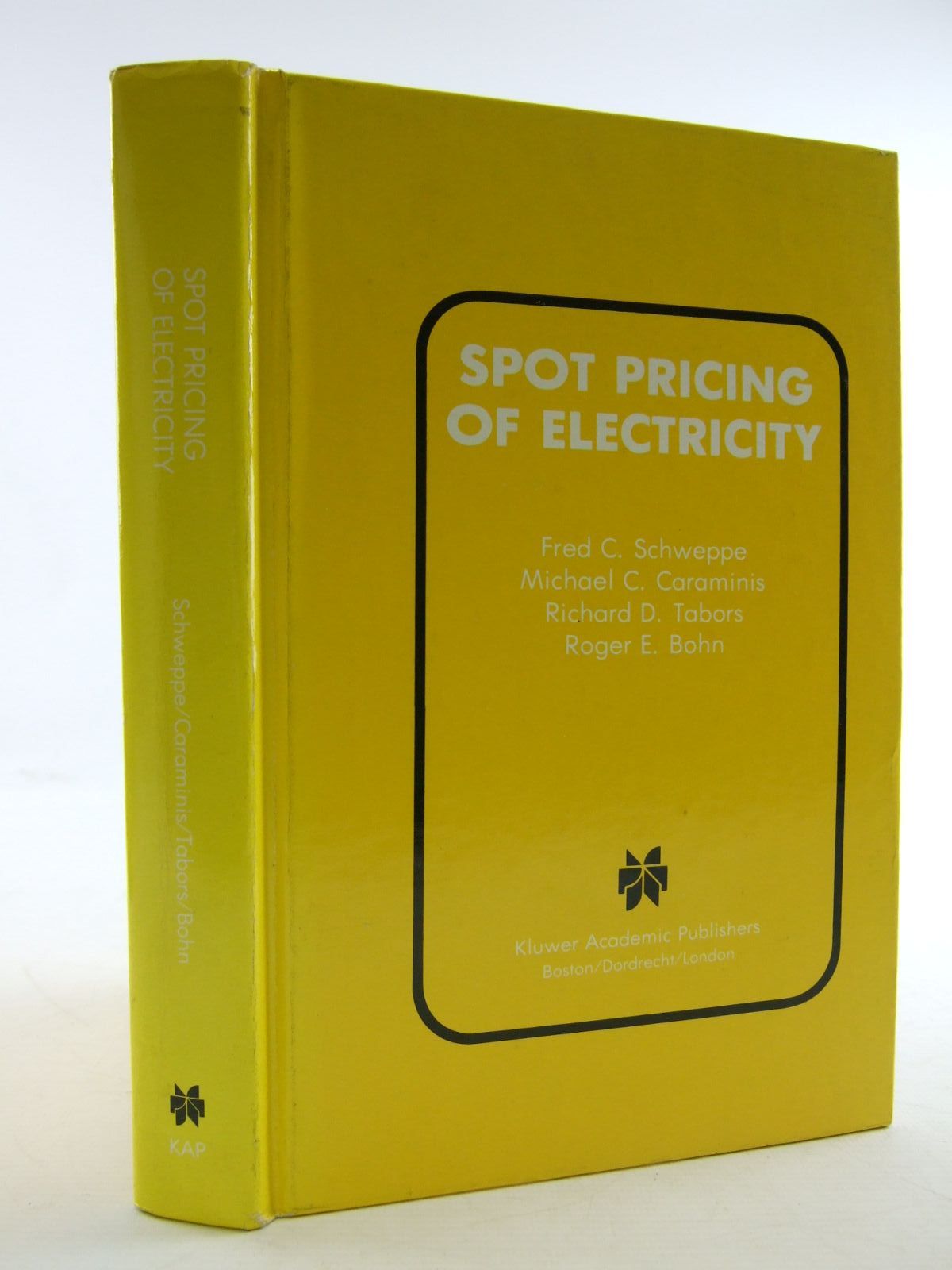
SPOT PRICING OF ELECTRICITY

by Fred C. Schweppe; Michael C. Caramanis; Richard D. Tabors; Roger E. Bohn

Published by Kluwer Academic Publishers. 1st. 1987

Nearly fine condition. The book presents a complete framework for the establishment of an energy marketplace where electric energy is treated as a commodity which can be bought, sold and traded in accordance with its time and space varying values and costs. The framework is based on the novel use of 'spot prices'. Yellow glazed boards. 355 pages.

Small inscription in ink to rear pastedown.

ISBN: 0898382602
Stock no. 1206440

Enquire about this book Add to Wish List

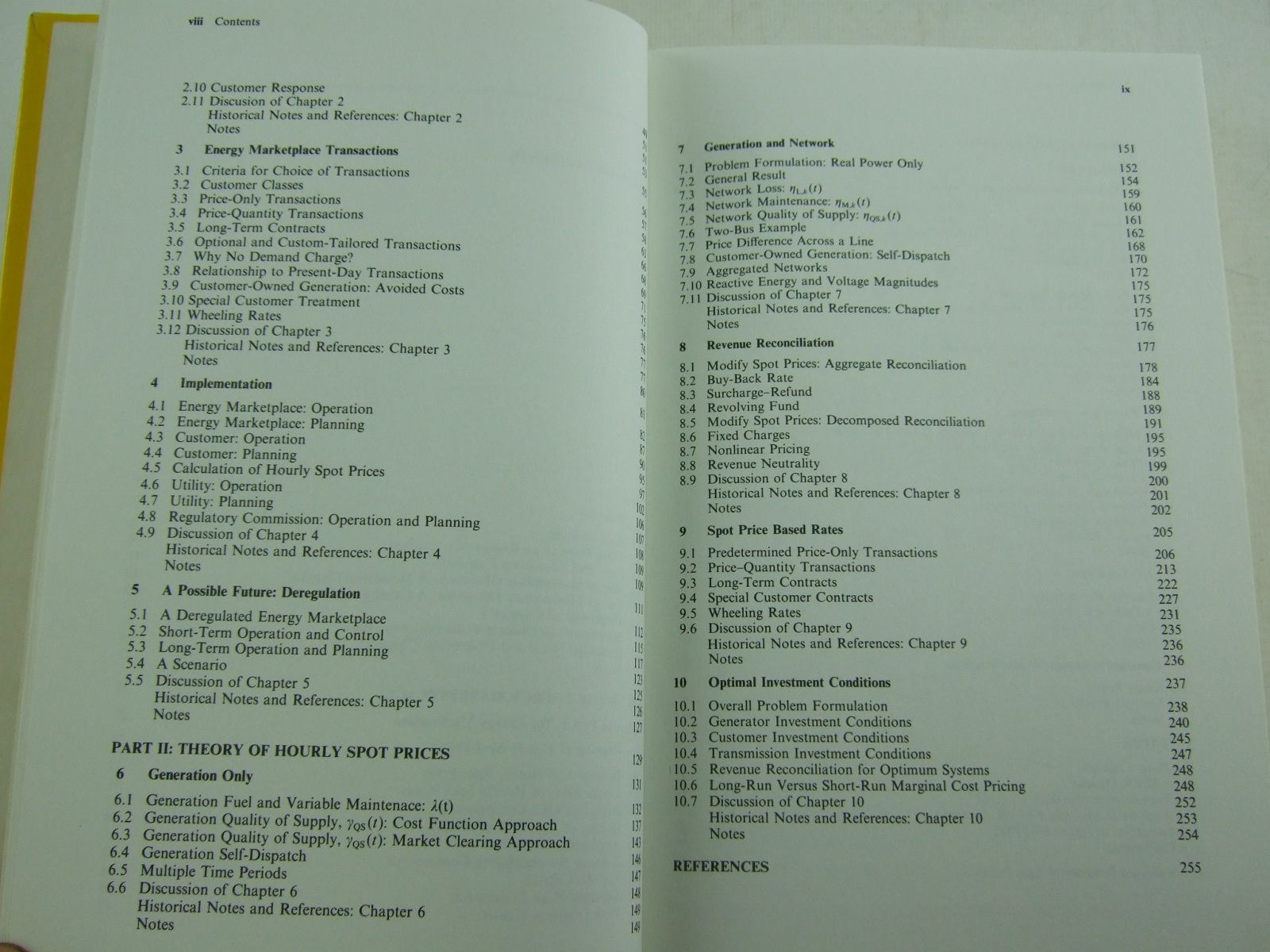
Contents

  • Preface
  • 1 Overview
  • 1.1 Goal of the book
  • 1.2 Three Steps to Energy Marketplace
  • 1.3 How Will Customers Respond?
  • 1.4 Energy Marketplace Operation: A Developed Country
  • 1.5 Energy Marketplace Operation: A Developing Country
  • 1.6 Discussion of Chapter 1
  • PART I: THE ENERGY MARKETPLACE
  • Preface to Part I: 1.4 Energy Marketplace
  • 2 Behaviour of Hourly Spot Prices
  • 2.1 Definition of Hourly Spot Price
  • 2.2 Components of Hourly Spot Price
  • 2.3 Operating Cost Components
  • 2.4 Quality of Supply Components
  • 2.5 Aggregated Network
  • 2.6 Revenue Reconciliation Componenets
  • 2.7 Buy-Back Rates
  • 2.8 Expected Price Trajectories
  • 2.9 Price Duration Curves
  • 2.10 Customer Response
  • 2.11 Discussion of Chapter 2
  • 3 Energy Marketplace Transactions
  • 3.1 Criteria for Choice of Transactions
  • 3.2 Customer Classes
  • 3.3 Price-Only Transactions
  • 3.4 Price-Quantity Transactions
  • 3.5 Long-Term Contracts
  • 3.6 Optional and Custom-Tailored Transactions
  • 3.7 Why No Demand Charge?
  • 3.8 Relationship to Present-Day Transactions
  • 3.9 Customer-Owned Generation: Avoided Costs
  • 3.10 Special Customer Treatment
  • 3.11 Wheeling Rates
  • 3.12 Discussion of Chapter 3
  • 4 Implementation
  • 4.1 Energy Marketplace: Operation
  • 4.2 Energy Marketplace: Planning
  • 4.3 Customer: Operation
  • 4.4 Customer: Planning
  • 4.5 Calculation of Hourly Spot Prices
  • 4.6 Utility: Operation
  • 4.7 Utility: Planning
  • 4.8 Regulatory Commission: Operation and Planning
  • 4.9 Discussion of Chapter 4
  • 5 A Possible Future: Deregulation
  • 5.1 A Deregulated Energy Marketplace
  • 5.2 Short-Term Operation and Control
  • 5.3 Long-Term Operation and Control
  • 5.4 A Scenario
  • 5.5 Discussion of Chapter 5
  • PART II: THEORY OF HOURLY SPOT PRICES
  • 6 Generation Only
  • 6.1 Generation Fuel and Variable Maintenance
  • 6.2 Generation Quality of Supply: Cost Function Approach
  • 6.3 Generation Quality of Supply: Market Clearing Approach
  • 6.4 Generation Self-Dispatch
  • 6.5 Multiple Time Periods
  • 6.6 Discussion of Chapter 6
  • 7 Generation and Network
  • 7.1 Problem Formulation: Real Power Only
  • 7.2 General Result
  • 7.3 Network Loss
  • 7.4 Network Maintenance
  • 7.5 Network Quality of Supply
  • 7.6 Two-Bus Sample
  • 7.7 Price Difference Across a Line
  • 7.8 Customer-Owned Generation: Self-Dispatch
  • 7.9 Aggregated Networks
  • 7.10 Reactive Energy and Voltage Magnitudes
  • 7.11 Discussion of Chapter 7
  • 8 Revenue Reconciliation
  • 8.1 Modify Spot Prices: Aggregate Reconciliation
  • 8.2 Buy-Back Rate
  • 8.3 Surcharge - Refund
  • 8.4 Revolving Fund
  • 8.5 Modify Spot Prices: Decomposed Reconciliation
  • 8.6 Fixed Charges
  • 8.7 Nonlinear Pricing
  • 8.8 Revenue Neutrality
  • 8.9 Discussion of Chapter 8
  • 9 Spot Price Based Rates
  • 9.1 Predetermined Price-Only Transactions
  • 9.2 Price-Quantity Transactions
  • 9.3 Long Term Contracts
  • 9.4 Special Customer Contracts
  • 9.5 Wheeling Rates
  • 9.6 Discussion of Chapter 9
  • 10 Optimal Investment Conditions
  • 10.1 Overall Problems Formulation
  • 10.2 Generator Investment Conditions
  • 10.3 Customer Investment Conditions
  • 10.4 Transmission Investment Conditions
  • 10.5 Revenue Reconciliation for Optimum Systems
  • 10.6 Long-Run Versus Short-Run Marginal Cost Pricing
  • 10.7 Discussion of Chapter 10
  • RFEFERENCES

Similar Stock