
Banned Books
 Governments through the ages have expended great energy in fighting wars with and against real live human soldiers. Perhaps what has not always been so apparent is the equal, and sometimes greater war that some of those governments have waged against the 'twenty six lead soldiers 'of the printing press.
Benjamin Franklin and Karl Marx both understood how the power of the printed word could issue a challenge more potent than any number of guns and bayonets. If we accept that writing, in some form, is at least 6000 years old then it may actually predate anything that we might regard as a sword. The pen might possibly be older than the sword, but the big debate has always been about which of them wields the greater power.
 In 1880 the printer and bibliographer William Blades published "The Enemies of Books". Among the enemies he described are "fire, water, gas and heat, dust, ignorance and bookbinders."
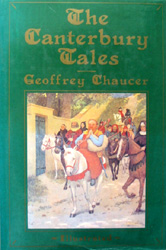
Right: The Canterbury Tales - banned for corrupting morals.
This quiet, though no less brutal war has been going on ever since those first marks representing words and ideas were pressed onto clay tablets. The name of the conflict is censorship.
This month the theme of the Stella Books window display in Tintern has been books which have all, at one time or another, been challenged, censored or just simply banned. When a book has been challenged, it has been subjected to scrutiny about its suitability to be in public libraries and to be used in education. Where it has been censored, part of the text has been removed or re-written in a different context to the original.
 Sigmund Freud's work was banned throughout Europe 1939-1945:-
"What progress we are making. In the Middle Ages they would have burned me. Now they are content with burning my books."
Banning would seem to be the ultimate sanction, forbidding the content of a book to be seen by anyone at all, but all too often there is a further stage to which the printed word can be subjected. It can be flagrantly, ostentatiously and publicly destroyed, usually by the act of burning. What greater example of the power of words can there be than the fact that this has not been a rare occurrence.
 Books being censored and banned is not a new thing of course. Putting a work by D. H. Lawrence in our window would certainly have made a point, but putting Roald Dahl's 'James and the Giant Peach' there instead makes a quite different one. Hopefully it arouses your interest in just why someone thought it necessary to censor this children's classic and thus opens up a debate on a lot of wider issues.
Right: James & The Giant Peach - banned for being disrespectful to adults.
"Censorship ends in logical completeness when nobody is allowed to read any books except the books that nobody reads."George Bernard Shaw. Irish playwright and critic (1856-1950)
 So why would Roald Dahl's work trouble anyone enough to want to ban or censor it?
In some countries his work is considered subversive because it portrays and encourages disrespectful behaviour towards adults. Even 'Little Red Riding Hood' is not immune to censorship, for in some versions of the tale she is taking wine to her grandmother and has therefore crossed the boundary of what is acceptable to some people.
Little Red Riding Hood - challenged for promoting alcoholism.
 "Did you ever hear anyone say, 'That work had better be banned because I might read it and it might be very damaging to me?'" - Joseph Henry Jackson
The reasons for banning books would fill a book by themselves; all that is necessary for censorship to flourish is a deeply held opinion and the desire and power to suppress alternatives.
Right: Arabian Nights - banned for being salacious.
I really hope that this month's window display and article will have stimulated some thoughts and ideas about the power of the printed word.
And of course, if it brings you into the shop to find out more, that can't be too bad either...
Contributed by Theresa Hucks
(Published on 15th Sep 2014 )