

CELL SIGNALLING
Written by John T. Hancock
Published by Oxford University Press
in 2010
ISBN: 9780199232109
- Categorised in:
- SCIENCE AND TECHNOLOGY
- BIOLOGY
- TEXT BOOK (UNIVERSITY)
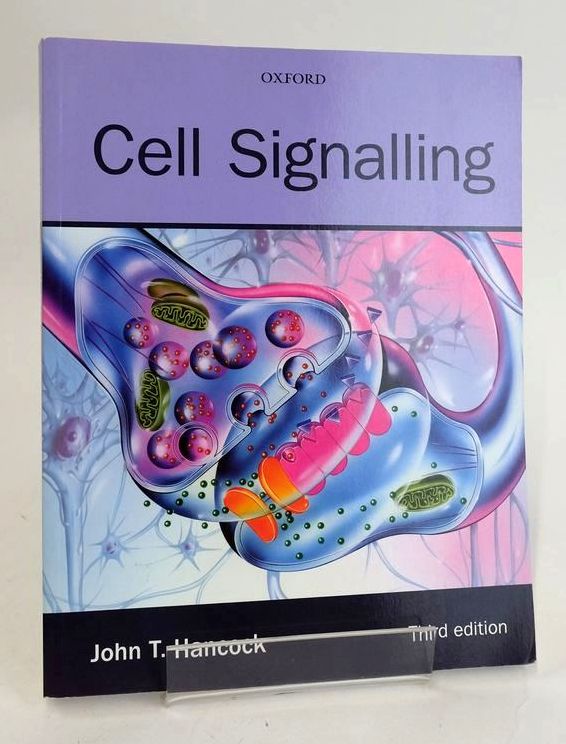
CELL SIGNALLING
Written by John T. Hancock.
Stock no. 1830481
2010.
Softcover.
Slightly better than very good condition.
Third Edition. Starting with an overview of cell signalling and highlighting its importance in many biological systems, the book goes on to explore the key components of extracellular and intracellular signalling mechanisms, before examining how these components came together to create signalling pathways, which are so crucial to the survival of living organisms. Pictorial cardwraps. Diagrams. xxii and 341 pages including index. ISBN: 9780199232109. Reprint. Mark to lower edge of rear cover (label now missing). Contents clean.
Front cover
Contents
- LIST OF FIGURES
- LIST OF TABLES
- LIST OF ABBREVIATIONS
- Part 1: An overview of Signalling
- 1 Aspects of cellular signalling
- 2. Pathways are the key to signalling
- 3 A Look at some of the history and techniques of cell signalling
- Part 2: Components that comprise signalling pathways
- 4 Extracellular signals: hormones, cytokines and growth factors
- 5 Detection of extracellular signals: the role of receptors
- 6 Protein phosphorylaion, kinases and phosphatases
- 7 Cyclic nucleotides, cyclases and G Proteins
- 8 Inositol phosphate metabolism and roles of membrane lipids
- 9 Intracellular calcium: its control and role as an intracellular signal
- 10 Reactive oxygen species, reactive nitrogen species and redox signalling
- Part 3: Selected examples of signalling pathways and events
- 11 Insulin and the signal transduction cascades it invokes
- 12 Perception of the environment
- 13 Signalling in development and for the regulation of gene expression
- 14 Life, death and apoptosis
- Part 4: Final thoughts
- 15 Cell signalling, importance, complexity and the future