

ENGLISH HISTORICAL DOCUMENTS VOLUME X 1714-1783
Written by D.B. Horn, Mary Ransome
Published by Eyre & Spottiswoode Limited
in 1957
- Categorised in:
- HISTORY
- HISTORY (BRITISH)
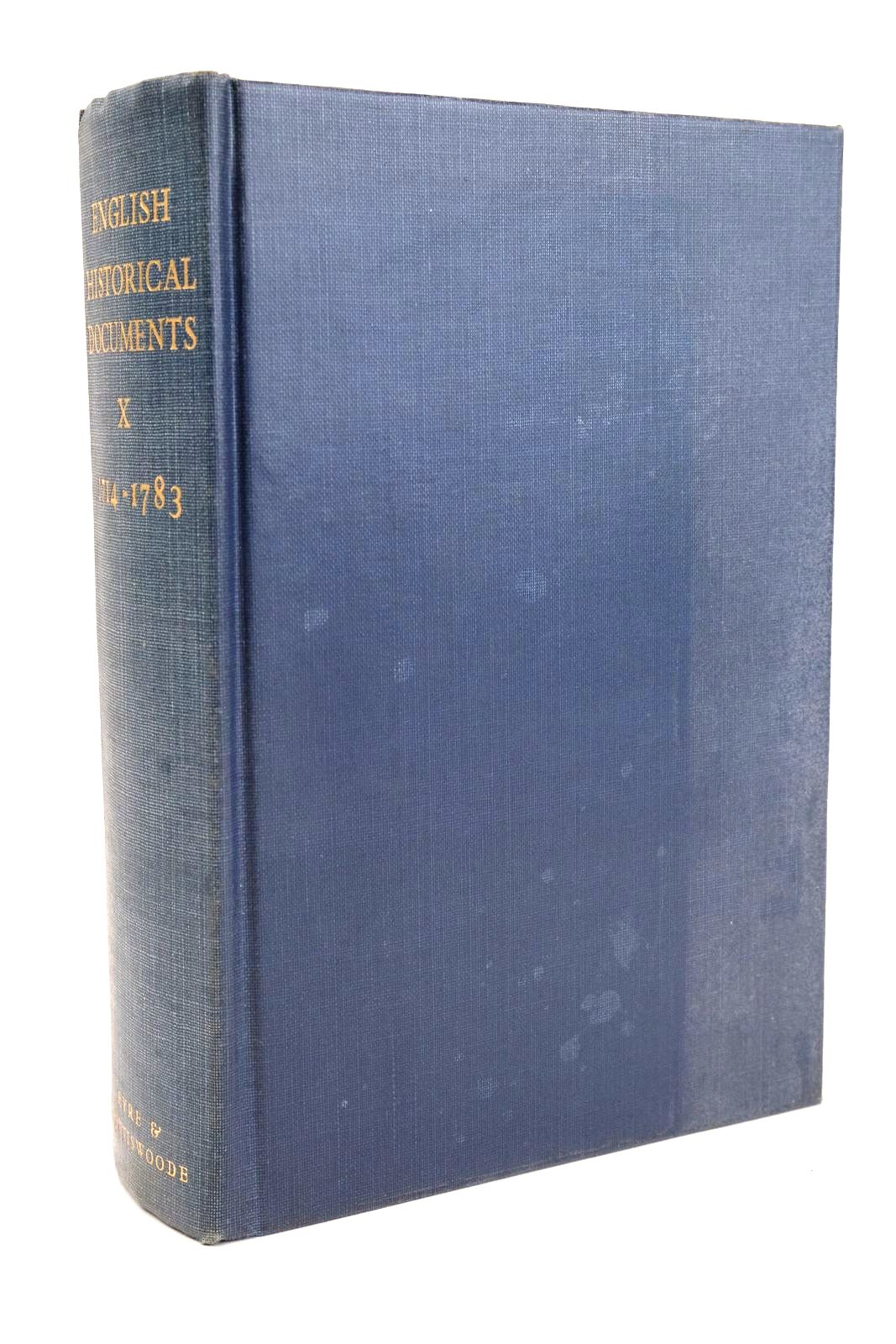
ENGLISH HISTORICAL DOCUMENTS VOLUME X 1714-1783
Written by D.B. Horn, Mary Ransome.
Stock no. 1330897
1957.
Hardback.
Good condition.
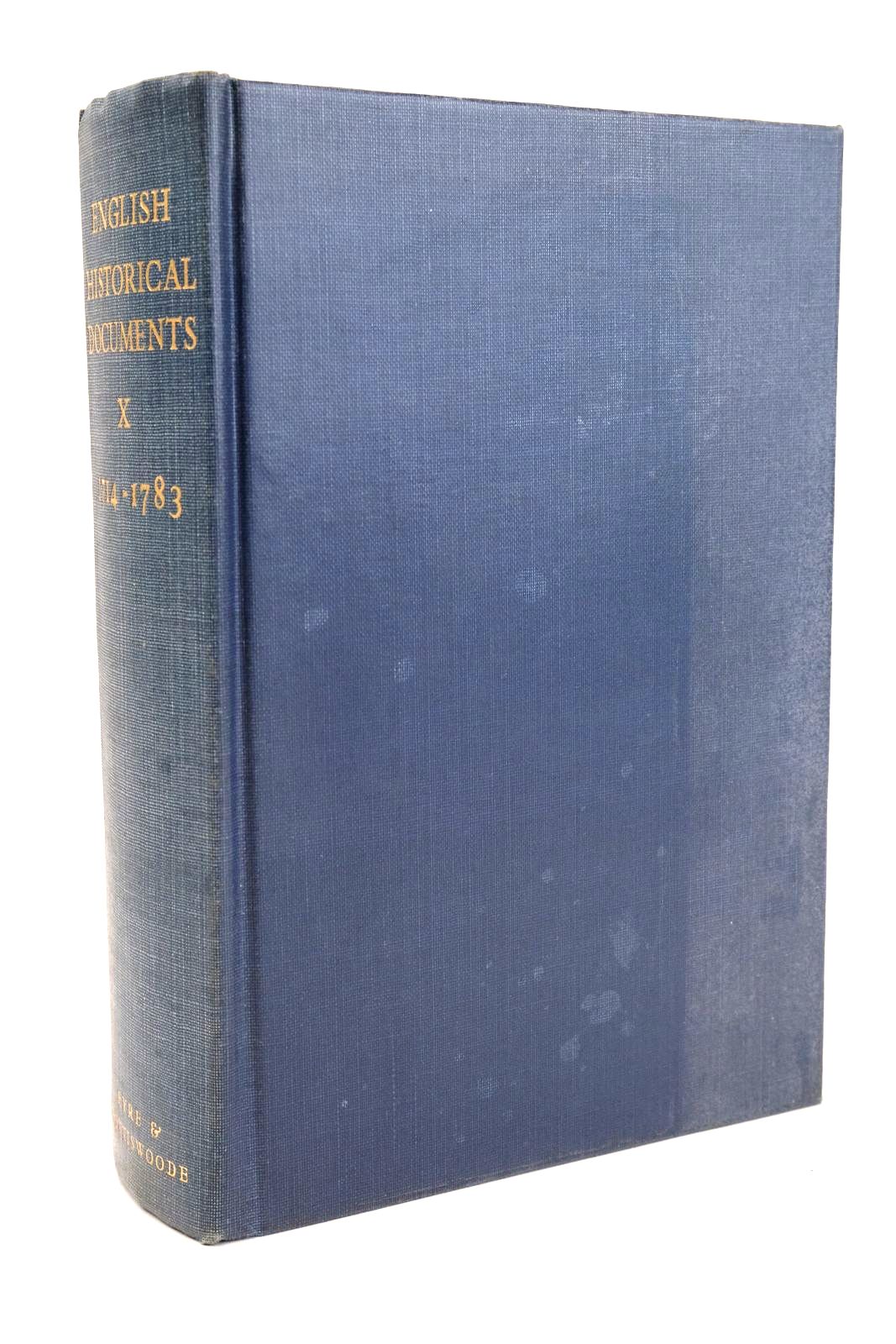
Blue cloth, gilt title to spine. 972 pages. Spine is faded and bumped. Front cover is lightly stained/marked, some light scuff marks to rear cover. Name and date in ink to front free-endpaper. Browning to endpapers and foxing to textblock.
Front cover
Contents
- Part I. THE MONARCHY
- Introduction to Part I
- Bibliography
- A. The Theory of the Constitution
- 1. Sir William Blackstone on the mixed nature of the Constitution, 1765
- 2. Jean Louis De Lolme's view of the stability of the English Constitution and the reasons for that stability, 1775
- 3. David Hume on "Whether the British Government inclines more to Absolute Monarchy, or to a Republic", circa 1740
- B. THE ROYAL FAMILY
- 4. Lady Mary Wortley Montagu on the Character of George I
- 5. George II and Queen Caroline on England and the English, 1735
- 6. Lord Waldegrave on the Character of George II and of George III as Prince of Wales, 1758
- 7. Nathaniel Wraxall on the Charter of George III
- 8. The Royal Marriage Act, 1772
- C. THE CROWN AND ITS MINISTERS
- 9. Letter from the duke of Newcastle to Lord Chesterfield on the ministerial crisis of 1746, 18 February 1746
- 10. Letters from Lord Hardwicke describing the ministerial crisis of 1757, June 1757
- 11. The Grenville Ministry state the terms on which they are prepared to remain in office, 22 May 1765
- 12. George III's view of the Grenville Ministry's behaviour to him, 1765
- 13. Letter from George III to Lord Bute on the 'King's Friends' and the Rockingham Ministry, 10 January 1766
- 14. Letters between George III and Lord North, June-November 1778
- 15. Letters from George Selwyn on the ministerial negotiations of March 1782
- 16. Letter from Lord North to George III insisting on resignation now that his ministry has lost the support of the House of Commons, 18 March 1782
- 17. Memoranda By George III on the negotiations ending in his unwilling acceptance of the coalition of North and Fox, 30 March-1 April 1783
- 18. Documents illustrating the fall of the Coalition government, December 1783
- 19. Sir Robert Walpole as 'Prime Minister'
- 20. The duke of Newcastle's proposals for increased solidarity amongst the members of the 'inner cabinet', 19 January 1745
- 21. Letters between the duke of Newcastle and |Lord Hardwicke
- 22. Extracts from the Diary of George Grenville, 1763-1764
- 23. Two views of the collective responsibility of ministers, 1741 and 1778
- 24. Speaker Onslow on the collective responsibility of ministers, circa 1765
- 25. Speech by Alderman Oliver in the House of Commons on 'responsible' and ' secret' advisers, 27 November 1775
- 26. The duke of Grafton disapproves of |Lord Shelburne's "view of becoming Prime Minister", 16 February 1783
- 27. Speech by Lord Shelburne in the House of Lords censoring ministers for their conduct towards Ireland, 1 December 1779
- Part II. PARLIAMENT
- Introduction to Part |II
- Bibliography
- A. Summons, Duration and Composition
- 28. Proclamation summoning the first Parliament of George I, 15 January 1715
- 29. The Septennial Act, 1716
- 30. Arguments for and against the Septennial Act, 1716
- 31. The Peerage Bill, 1719
- 32. A Place Act, 1743
- 33. A Place Act (Members), 1782
- 34. A Place Act (Electors), 1782
- B. Proceedings
- 35. Formal business in the House of Commons at the beginning of a session, 6 August 1714
- 36. Horace Walpole's account of the different styles of oratory in the House of Commons, circa 1755
- 37. Carl Philipp Moritz's description of the House of Commons, 1782
- C. Privilege
- 38. John Wilkes and The North Briton, 1763
- 39. John Wilkes and the Middlesex Election, 1769
- 40. Speeches by Sir William Windham and W9ill9iam Pulteney on the reporting of debates, 13 April 1738
- 41. The Case of Brass Crosby, 1771
- D. Elections
- 42. Expenses of Sir Robert Kemp, Bart., in his son's election at Orford, 1730
- 43. Extracts from the Diary of George Bubb Dodington, 1753-1754
- 44. Election petitions, March 1738
- 45. The Grenville Act, 1770
- 46. Carl Philipp Moritz's description of an election, 1782
- E. Political Parties
- 47. An account of political parties at the accession of George I. 1714
- 48. Letter from Lord Chesterfield to George Bubb Dodington
- 49. A pamphlet on the wickedness of 'faction', 1761
- 50. Speech by Lord Sandwich in the House of Lords, 22 November 1770
- F. The Movement for Parliamentary Reform
- 51. Speech by Lord Chatham in the House of Lords on parliamentary reform, 22 January 1770
- 52. Major John Cartwright on the evils of long parliaments, 1776
- 53. Petition and Resolutions of the Yorkshire Association, 1779-1780
- 54. Letter from Lord Rockingham to Pemberton Milnes on parliamentary reform, 28 February 1780
- 55. Letter from Lord Shelburne to the chairman of the Wilshire Committee, 26 March 1780
- 56. The duke of Richmond's plan for parliamentary reform, 3 June 1780
- 57. Prospectus and List of Members of the Society for Constitutional Information, 1780
- 58. Speech by William Pitt in the House of Commons on parliamentary formation, 1780
- 59. Speech by Edmund Burke in the House of Commons against Pitts proposal, 7 May 1782
- Part III. THE LAW AND ITS ADMINISTRATION
- A. The Law
- B. Central Administration and the Keeping of Order
- C. Local Government
- Part IV. PUBLIC FINANCE
- A. Revenue and Expenditure
- B. Customs and Excise
- C. Direct Taxes
- D. Financial Administration
- E. The National Debt
- Par V. THE CHURCHES
- A. Church and State
- B. The Condition of the Church of England
- (a) Ecclesiastical Revenues
- (b) The Work of the Clergy
- C. The Methodists
- D. Non Conformity
- (a) The Protestant Dissenters
- (b) The Catholics
- Part VI. THE STATE OF TE NATION: ECONOMIC
- A. Agriculture
- B. Industry
- (a) Textiles
- (b) The Midland Industries
- (c) Mines
- C. Combinations of Workmen
- D. Trade
- E. Some Population Statistics
- Part VII. THE STATE OF THE NATION: SOCIAL
- A. Social Life
- B. Transport and Communications
- C. Humanitarianism
- D. Education
- Part VIII. THE ARMED FORCES
- A. The Navy
- (a) Recruitment and General Conditions
- (b) Administration
- (c) Tactics and Fighting Instructions
- B. The Army
- (a) Recruitment, Discipline and General Conditions
- (b) Unpopularity of a Standing Army
- C. The Militia
- Part IX. SCOTLAND
- A. The Church
- B. The Highlands and the Risings of 1715 and 1745
- C. Scotland after 1745
- Part X. IRELAND
- A. Relations with England
- B. Religion
- C. Economic and Social Conditions
- Part XI. THE COLONIES
- A. Eighteenth-Century View on Colonies
- B. Colonial Trade
- C. General Organization
- D. America
- (a) The Thirteen Colonies
- (b) The West Indies
- (c) Canada
- (d) Nova Scotia and Newfoundland
- E. India
- F. Africa
- Part XII. FOREIGN POLICY AND WARS
- A. Policy
- B. Wars
- (a) War of the Austrian Succession
- (b) Seven Years War
- (c) War of American Independence
- C. Treaties
- Appendices
- Diagrams
- Maps
- Index to Texts